• Skip to main content

Environmental Nonfiction

  • Home
  • About
    • Awards
    • Writing at Pitt-Bradford
    • Submissions
    • Contests and Special Features
    • Editorial Staff
  • Contributors
  • 2026 Edition
    • Editor’s Note
    • Climate Fiction & Graphic Narrative
    • Art
    • Environmental Nonfiction
    • Poetry
  • Past Issues
    • 2025
    • 2024
    • 2023
    • 2022
    • 2021
    • 2020
    • 2019
    • 2018
    • 2016
    • 2015
    • 2013
    • 2012

Everything Has a Purpose

 By Roxy Kinzer-Barr 

A few short months ago, I did not think I would be where I am now. I keep writing and talking about the feelings that I had previously; however, each time I voice them, I do not make any progress as to why this tugs on me so much. Getting words out is hard, and it’s strange that it’s something I’ve struggled with recently, as one of the biggest aspects in all of my classes is the fact that I must clearly and effectively communicate. However, I cannot. My feelings are jumbled. I feel lost.  

Yes, I’m doing okay now. Yes, I have good grades. Yes, I communicate with my family now, and it’s not just when I need to sob. But am I okay?  

I came to Pitt with big dreams and goals. I wanted to be an exotic veterinarian, for I wanted to give these special animals a voice and another chance. Scorpions, tarantulas, snakes, crocodiles, insects, anything weird or out of the norm that you could think of was always something that piqued my interest. I wanted to help these animals, as everyone believes they are separate from your typical dogs, cats, hamsters, and more. No one ever thinks about the purpose and significance of these “scary” animals. 

Now, I am no longer pursuing the path of becoming what was previously stated. It was like a sudden death; I had the concept grasped so tightly in my hands– dreaming, wishing, praying to a God I don’t even believe in. Then, it was gone. When an advisor looks at an 18 year old girl’s face and tells her, “it’s almost laughable that you want to pursue this. You’ll never get into graduate school with these grades,”  I think the 12-year-old farm girl in the deep south died. The girl who helped her father whelp puppies died. The girl who figured out she was getting her first reptile at 15 died.  How is that okay? How are we letting a man tell someone that they will never pursue their dreams?  

I try to accept what happened. I go back and forth in my mind, trying to understand why he said those things to me. He’s right– my grades weren’t good. It was a time in my life when I was adjusting to a place far away from home, far away from the animals I loved, far away from friends and loved ones. He’s right– I am good at other things, and maybe I should embrace them. So, here I am, embracing writing. Writing about the fact I was pushed out of STEM rather than fighting for myself.  

At least now, I can write and spread awareness about the species that I care so deeply about. Maybe a man will be a better veterinarian than me because he made an A+ in chemistry while I made a C.  

Or is this a powerless mindset? Is there a missing piece in this time period of my life that I am not recognizing?  

I know that it indeed is. I’ve noticed lately that as I research the more complicated and lesser known animals for my essays in my composition classes, there are barely any credible articles or sources to support what I am so desperately trying to say. Why do these animals not have a voice? 

When I try to talk to my friends or professors about why these animals are so important to me, the first response is, “Ew! I could never. You do you.” Why are so many people doubting the beauty and complexity of all of these species?  

Maybe I am like the odd animals that society for years to come have not been able to accept? The amblypygi, (funny that Google Docs is trying to tell me this is not a word) a species of whip-spider that is not too well known, and when people do find out about its existence, the poor baby then faces disgusted remarks due to its crazy legs and strange pinchers. A scorpion and spider hybrid if I had to describe it to someone. I will admit, they are not pleasing to the human eye. However, these animals are so important to current research, as they allow scientists to understand insight on sensory biology, which is used by the whip spiders to hunt their prey. Everything, even when it is not exactly recognized, has a purpose.  

As you can see, how can a species of animal be so incredibly important in the scientific world, yet cannot be recognized by Google Docs? How is this animal so unique and so strange within the animal kingdom, but it does not get any recognition? I would like to believe that our present day writers are similar to the amblypygi. Writing is ever-changing: words evolving, ideas constantly thrown into the pot, strong emotions portrayed that have been shown to affect the lives of many people, as well as ideas that are groundbreaking throughout many aspects of life, not just in the world of writers.  

 I remember reflecting during that meeting; there were so many excessive, unsure, and unkempt thoughts. I would like to elaborate on what exactly I was thinking; however, now that I look back, I understand that there was a deeper meaning within that experience. My thoughts were not significant within that time period; however, the fact that I was about to discover who I really am was. Everything, even when it seems like it’s crushing your world, has a purpose.  

I hope to embrace the fact that I am here to write. Science did not work for me, but writing did. Sure, my advisor was right. I will not make it to a veterinarian graduate school, but I sure as hell hope to give animals the recognition they deserve through my writing and my words.  

Even now, I still undergo the constant toxicity from others telling me that writing is not going to work out in the long run. A few months ago, I told myself to listen to the man that had decided to crush me. Today, I refuse to succumb to something like that ever again. Today starts with advocating myself, and as I progress within that, I hope to defend those who cannot help themselves, such as the amblypygi.  

https://2026.bailysbeads.org/everything-has-a-purpose/

Filed Under: Environmental Nonfiction

  • Home
  • About
    • Awards
    • Writing at Pitt-Bradford
    • Submissions
    • Contests and Special Features
    • Editorial Staff
  • Contributors
  • 2026 Edition
    • Editor’s Note
    • Climate Fiction & Graphic Narrative
    • Art
    • Environmental Nonfiction
    • Poetry
  • Past Issues
    • 2025
    • 2024
    • 2023
    • 2022
    • 2021
    • 2020
    • 2019
    • 2018
    • 2016
    • 2015
    • 2013
    • 2012

Coquina

By Angelique Burns 
As the sun beats down, toasting the seashell sand on the beach, the saltwater splashes with a frightful intensity along the shoreline then rushes back into the ocean as if chased by an invisible predator. It leaves behind shallow water and freshly tilled beige sand, along with all the creatures that burrow within it. I love to feel the coquina tickling my toes as they burrow themselves over back to safety after the tide pulls them once again from the sand to deposit them inches away to another location. 

As a child, I would stand still on the shoreline watching the cool white capped tide flow back and forth over my feet for hours. The rhythm of the ocean was hypnotizing; standing on the beach was just about the only time I could stand still(I know now that I was a child with undiagnosed ADHD).  There was just something about the white salty foam washing the hot sunbaked sand over my feet and back into the ocean; the sand felt as though it was melting away from under me taking my worries away with it, while those tiny little shells tickled my feet.  

But what I didn’t realize then was that it was a sort of meditation.  

A quieting of the mind.  

I did not fully understand that I was starting to block out the toxicity of my home life.  A coping strategy I became so good at that it wasn’t until my forties that I learned wasn’t normal, and I was part of a group I never knew existed.  

Children of addicted parents.  

There seems to be a label for everything these days.  

We didn’t think of it as an addiction back then when the pills were prescribed by a physician. Mom took pills. Lots and lots of pills.  Eleven different pain killers or muscle relaxers a day to be specific. But they were prescribed- so they couldn’t be bad right? The pain was real, the doctors know what’s right, so who are we to question them? Oh, how thingshave changed since those days.  

We also didn’t discuss mental health as we do now. Even if we had,I was a child, no one would have discussed it with me anyway.  I just knew that I didn’t make noise if mom was in bed. And if she was awake, the noise was for outdoors play only and silence was for inside. If the phone rang, I answered fast before the answering machine started that loud clicking as the tape kicked in, and I knew better than to invite friends over, never knowing if it was a good day or a bad day to have company.  

So, I just never had company. 

I spent many years navigating around mood swings that I became an expert on body language. I’ve had people tell me that’s a sign of being an empath, so I wonder how many empaths are created out of a childhood full of trauma?  

A good day meant mom may have had enough sleep to tolerant of my friends. This was usually a day that started with her up early wearing a bathing suit, a thick layer of coconut scented Coppertone Dark Tanner on her skin with a faint hint of lemon and peroxide that she would spray in her hair for that sun touched blond look, and the overwhelming smell of Kool Menthols always in the air. I would wake up to Eurythmics or maybe a Bonnie Tyler tune playing loudly from the stereo in the living room. She would be cleaning or ironing leaving a heavy scent of lemon pledge and that weird spell of burnt starch that coated the bottom of iron in a sticky brown layer that never seemed to come off in the air(Mom had the most startling bright, white, stiff, starched tuxedo shirts for work I have ever seen). Shortly after, she would take a break to lay on the hot plastic lawn chair, baking her skin into a deep brown tan my skin never managed to reach.  

A bad day?  

That would start with banging doors or pots and pans to subtly wake me up. This meant all my plans (if I bothered to attempt to make plans) were about to be canceled. I was about to spend the day trying to appease mom’s mood until she either went to work or went out with her friends to the bar. I would nervously look for the opportunity to call my friends to say I wasn’t coming while trying to sweep up dog hair just the way mom wanted it the first time so I didn’t get yelled at, praying for the moment she worked it out of her system so I could close myself up in my room to read my newest novel while blasting some anger managing music of my own. This was my metal stage in life.  

In contrast to the rest of the house that was brightly lit by the Florida sun beaming through old jalousie windows that never seemed to stay in place, my sanctuary was a cave of dark gloom with Tapestries of Ozzy Osbourne and Black Sabbath hung from the ceiling, while posters of Megadeath, Queensrÿche, Slayer, Anthrax and many more were plastered where once the bright colors of Cyndi Lauper, Madonna, Whitney Houston and other pop stars once graced my walls.   

I got good at coming up with excuses as to why I had to hang at my friends’ homes, and they couldn’t come to mine. I think a few knew more than they let on, like my best friend Amy. Her mom and my mom were close as well, so when I think back on all the times, I was invited to spend weekends at their house I wonder how much of that was to give me a break from home. 

Amy was the only one that could come to my house at any time uninvited. 

She knew the rules. She didn’t come over often.   

On the occasions when mom was off work and in a mood to deal with me, she would pack her old Chevette up with lawn chairs, shovels, towels, dark tanning lotion for her and a high SPF for my pale pasty skin that would inevitably have sun poisoning before the day was through, and we would hit the beach.  

These were VERY good days. These were the days that I fell in love with the beach. 

I never got yelled at there.  

I could be whatever I wanted to be. 

But most of all I was at peace there. The sun shined, the misty salty air tangled my unruly curls, and the hot sand rubbed off any stress I was feeling as I did the crab run across it to get the coolsand at the water’s edge as if I was a rough stone being tumbled in a rock tumbler to become a shiny new bauble, while the sounds of the white foam hitting the shore became my soul reviver.  

Now as an adult I can still find that peace, I just need to put my feet in the dirt to calm my mind. Just a few minutes and I can see the world and any problems I’m facing just a little bit clearer.  

Feet to the earth.  

Toes in the sand. 

This is how I heal my soul.   
https://2026.bailysbeads.org/coquina/

Filed Under: Environmental Nonfiction

  • Home
  • About
    • Awards
    • Writing at Pitt-Bradford
    • Submissions
    • Contests and Special Features
    • Editorial Staff
  • Contributors
  • 2026 Edition
    • Editor’s Note
    • Climate Fiction & Graphic Narrative
    • Art
    • Environmental Nonfiction
    • Poetry
  • Past Issues
    • 2025
    • 2024
    • 2023
    • 2022
    • 2021
    • 2020
    • 2019
    • 2018
    • 2016
    • 2015
    • 2013
    • 2012

Tulsi

By Nehal Palan

Author’s note 

This is the first draft of a piece based on the exercise we did where we had to write about a family tradition that we kept up even though we didn’t understand it. My mind immediately went to my mom’s collection of plants that have surrounded me for as long as I could remember, though I didn’t know what most of them were. Like my last piece, I tried to sprinkle in some facts about the plants with the personal narrative, so I would like to know how the flow of that is and if they blended well. I am unsure about the ending and it doesn’t really feel complete, but I’m not sure how to end it, so any ideas you have about that would be much appreciated. As always, thank you for reading and I look forward to hearing your thoughts! : ) 

blue tan swoosh divider graphic

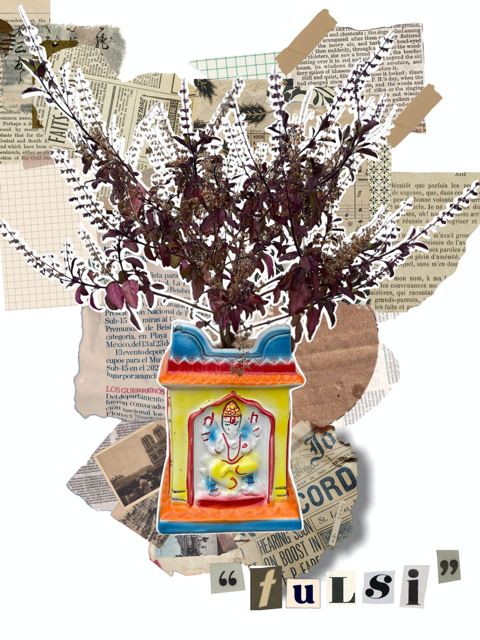
Tulsi. When I say that word to you, you probably have no idea what it means. Maybe you’re thinking that’s a pretty name. And while I would agree with that, I would also add that it’s more than a name, it’s the name of a sacred Indian plant. Tulsi is just one of the 20 plants I grew up surrounded by. My mom is an avid plant lady, though I wouldn’t venture to call her a “gardener” because it’s not like she grows carrots and potatoes although we did have a chili plant on the side of our house at one point. The plants she has are all different essential Indian ones, and the way Indian English operates, she would call them all tulsi. 

Ocimum tenuiflorum, commonly known as holy basil or tulsi in Sanskrit, is an aromantic perennial plant in the Lamiac family. It’s widely cultivated throughout the Southeast Asian tropics and native to tropical and subtropical parts of Asia, Australia, and the western Pacific. It’s cultivated for religious and traditional medicine purposes, as well as for its essential oil. It is widely used as an herbal tea and has a place within the Vaishnava tradition of Hinduism, where devotees use it for worship.1 

One of her other plants you would know as lemon grass, or lili chai in India,which is a perennial, aromatic tall grass with a light lemon scent used for culinary and medicinal purposes. For centuries, herbalists have used the herb as an effective digestive tonic and nervous system relaxant. The oil of the plant is used to help clear blemishes and maintain a balanced skin tone. Additionally, it’s also used as an insect and mosquito repellent.2 

I never really understood the reason why we had the tulsi; it is just became one of those constants in the background of my life that I never really questioned. While it’s used for medicinal purposes, I don’t think my mom ever used it for that. We also have a money plant that I think might be older than I am. It sits in the back corner of our dining room in a green pot elevated on a little black metal table. Although now, it has a cardboard barrier around it to keep our cat away from it. I remember asking my mom about this plant when I was younger and when she told me the name of it, I was fascinated. Wow, a plant that can grow money? That’s amazing! Of course, the expression that “money doesn’t grow on trees” holds true because that plant could not, in fact, grow money. I learned later on that it was called that because it is believed to bring wealth. 

The Pachira aquatica goes by many names, including Malabar chestnut, French peanut, Guiana chestnut, Provsion tree, and Saba nut. It is sold commercially under the names Money tree and Money plant. It is a tropical wetland tree in the mallow family Malvaceae that is native to Central and South America where it grows in swamps. It is sometimes sold with a braided trunk and is commonly grown as a houseplant.3 

The location of my mom’s herd of plants alternated with the seasons. During the spring and summer, she would put them on the outside steps leading to our front door. It’s kind of ironic now because all the other plant life that used to populate our front lawn slowly diminished over the past few years, to the point that now, it’s a barren grassland. It’s almost like she took all the available plant power and put it in her pots. When the seasons changed and it grew colder towards the middle-end of fall, she would move all her tulsi inside and huddle them all on a table together. This table used to sit right next to the front door, but she has started putting them on our kitchen table, since it was never used anyway, to have them more out of the way. 

I was excited when we first got the chili plant, as well as later when we got a cherry tomato one. The idea of growing some of our own vegetables intrigued me, and I loved checking the plants every day to slowly watch the chilis and tomatoes ripen. I’d always wanted my mom to have a full garden in our backyard, but she always told me that she didn’t have the time to care for that many plants on top of the ones she already has. It seems she was right considering that both the chili and tomato plants ended up dying. She did have a mini greenhouse in our backyard that she got off Amazon for around two days, but it got blown over by the wind. 

Soon after we got our cat Mochi and my mom noticed him trying to eat her plants, she got some special pet grass for him to eat. It sits on a little side table right next to our microwave, but ironically, it still seems he likes my mom’s plants more than the grass, since he hardly eats the grass and still tries to get to her plants. 

Cat grass is typically grown from rye, barely, oat, or wheat seeds. It’s different from grass that naturally grows outside, as that has the potential to contain toxic pesticides. It can be used as a deterrent to lure pets away from dangerous or delicate plants.4 

Now when I go home for the holidays, I can still find my mom tending to her tulsi, whispering encouraging words to them and shooing the cat away from their springs.

https://2026.bailysbeads.org/tulsi/

Filed Under: Environmental Nonfiction

  • Home
  • About
    • Awards
    • Writing at Pitt-Bradford
    • Submissions
    • Contests and Special Features
    • Editorial Staff
  • Contributors
  • 2026 Edition
    • Editor’s Note
    • Climate Fiction & Graphic Narrative
    • Art
    • Environmental Nonfiction
    • Poetry
  • Past Issues
    • 2025
    • 2024
    • 2023
    • 2022
    • 2021
    • 2020
    • 2019
    • 2018
    • 2016
    • 2015
    • 2013
    • 2012

Birth

By Adriana Herrera 

Sharks are born in three different ways. The first is a live birth; the second is through hatching from a deposited egg. The third is a mixture of both, where the egg hatches in the wombs and the babies then fight for the right to be born before they are considered alive. From there they learn to live on their own, growing up firstly in secluded areas that can identify as a nursery before being brought out into the ocean. The ocean, the biggest open space of pestilence and pollution where they will then be given the opportunity to be killed by overfishing or the often inept hunter. 

Because they were born. 

Axolotls have very cute births. They are born from eggs that are fertilized after a male and female axolotl dance together in courtship. After this dance, there is then a rock or plant chosen for the eggs to be laid individually, which is a way to protect their babies from predators. It will take two weeks for the eggs to hatch. Following a cute coupling and extra protection, two weeks after these creatures have been born, they will die. Their waters are desecrated, their habitats destroyed. The droughts that come before the forgiving rains are the only things that say goodbye to them as they leave the Earth. 

Because they were born. 

Cheetahs have a special call, a yelp if you will. Through the female’s estrous cycle, the males will let out yelps, to which the female can decide if she would like to mate or not. The gestation period then takes up to 95 days. Most litters have around 3-5 cubs at a time; these sweet little lives born with the most gorgeous of silver fur on their backs. This silver fur puts a target on them immediately. What poacher wouldn’t want the fur of a silvery little feline to hang up and show off? Mass hunting creates a domino effect, one that has led cheetahs to despair. 

Because they were born. 

Homo sapiens. These creatures are born after a mother and father love each other or don’t love each other. This gestation period lasts up to 9 months; sometimes even less if the fetus or baby is heavily affected. But unlike the cheetah, axolotl, and shark, Homo sapiens are not all perceived to be born the same. No, some are born with higher value while others are regarded as less because of the lands they were born on. Many Homo sapiens have had their lives threatened for simply being that of a different variety of the species. In many minds of the Homo sapiens, one group is superior to the others. This superiority causes a rift, a rift so large that it causes one group to hate the other so much until it eventually destroys both. 

I am a Homo sapien. 

I am not what one would consider one of the superior Homo sapiens. 

My life will be threatened, my home will be pillaged, and my skin will be what gets me targeted. 

Because I was born. 

https://2026.bailysbeads.org/birth/

Filed Under: Environmental Nonfiction

  • Home
  • About
    • Awards
    • Writing at Pitt-Bradford
    • Submissions
    • Contests and Special Features
    • Editorial Staff
  • Contributors
  • 2026 Edition
    • Editor’s Note
    • Climate Fiction & Graphic Narrative
    • Art
    • Environmental Nonfiction
    • Poetry
  • Past Issues
    • 2025
    • 2024
    • 2023
    • 2022
    • 2021
    • 2020
    • 2019
    • 2018
    • 2016
    • 2015
    • 2013
    • 2012

A January Flower: The Carnation

 By Madyson Trama 

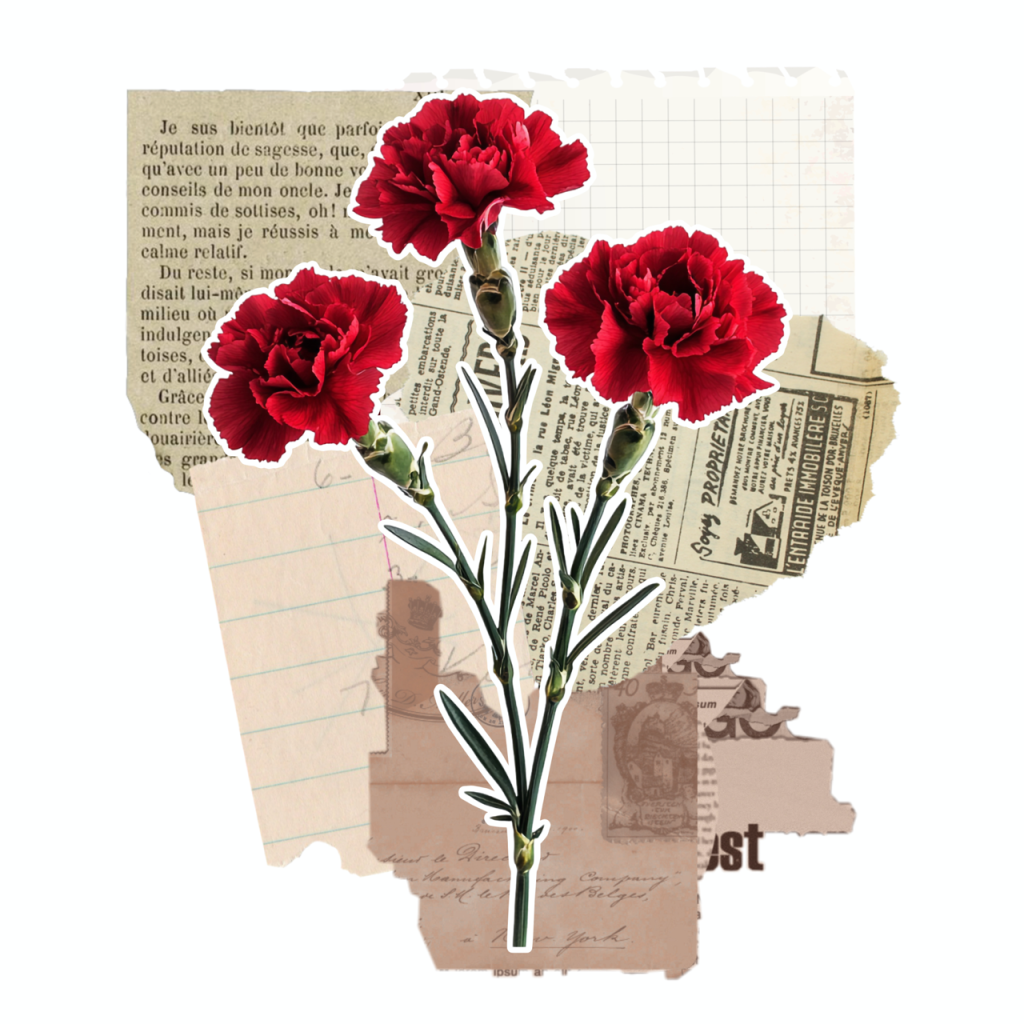
Carnations by Nehal Palan

Being born in the month of January means having a flower that correlates to the gift of life that I was granted in this cold, dreary winter month. Not to mention how the days feel like they drag; instead of thirty-one days, it feels like a never-ending cycle. It can also be a bit ironic to talk about flowers during this chilling time, but no matter the season and weather they are always blooming. The carnation to be exact-even during the most difficult of weather conditions, beauty still chooses to prevail.

I got familiar with the carnation while growing up. The carnation is a common flower and isn’t seen in the greatest light. The flower has been given the nickname “cheap” and “the grocery store flower” because of how commonly it can be found. . It is also known for having the spotlight when creating beautiful bouquets, and, because of their hefty bulb, they add a larger-than-life element to all sorts of different arrangements. For me though, my acquaintance with the flower started when I was much younger, and it was making appearances through my life when I least expected it. Finding myself getting lost in my grandmother’s garden was something I did as a kid. Between the enormous butterfly bush at the top of the hill in her backyard, to the tomatoes and cucumber plants that lined the stone steps up to the black top—you could find me wandering around and creating my own tour of the flowers and plants.  

At the top of the stone steps that have grown wobbly, there was a lush bush of lavender that swayed when the wind would blow through it. Softly penetrating the air with its delicate, powdery scent. With its light intoxicating aroma it wasn’t difficult to pinpoint where I would be most of the time when I was out in the garden, but if you looked a little to the left of the lavender bush I could be found hovering around the clump of carnations. I always loved to pick them and surprise my grandmother. Granted, she knew where they came from but still acted like she appreciated it. I always loved to pull the petals off and rub the velvet like softness between my fingers and rub hard enough to see if the color would bleed off and stain my fingers. 

The thought of having the flowers’ vibrant purple and white color tattoo my skin was something I was more than happy to sport around as long as I could. Having the color that I was so mesmerized by come onto my skin left me in amazement and made me wonder if all the beauty in the world could come into contact with anyone or anything. I was curious if that’s how other things got their elegance, from being around what brought it out in them. Along with being in my grandmother’s backyard, I started to point out the carnation in other situations when I wasn’t expecting to see it I became excited when I realized that it didn’t take much to see this plant around, even more so when I started to see it in different colors.  

One instance where the flower was handed to me was a parade of all places. The St. Patrick’s Day Parade that took place in downtown Scranton, PA in the month of March. The weather was bleak, the sky a light gray and the sidewalk colored in a deeper beige from the sporadic rainfall . Though the chill of the cold rain was in the air, the smell of spring was in the breeze. I remember after I had finished with my partaking in the parade of being a baton twirler, and thankfully starting early in the parade, I got to watch the ending of it with the rest of my family. When I wasn’t paying any attention to what was going on around me, that’s when the flower was presented to me by an older gentleman who was handing it out happily to those around. It was a green and white carnation that looked like it was painted with amint green color, and then the edges of it were dip-dyed in a dark, forest green that highlighted the ruffles of the petals perfectly.  

In that moment I realized that I didn’t have to be just in my grandmother’s backyard to get close to the plant, and I also wasn’t limited to just one color. Instead, I was opened up to the different vibrant shades that a carnation canportray. I learned that it could be a deep red, a pale pink, stark white, a chalky yellow, mint green and of course an aubergine purple. My favorites are when two colors are paired, such as purple and white or the green and white. The ruffled petals on the flower remind me of the tutus that I worefor ballet when I was younger. Those were the flowers I received after my ballet or twirling recitals. I had a whole bouquet to call my own, and I was able to admire it until the petals wilted and fell crowding the water the stems rested in. When I didn’t even want to be on the stage to begin with due to my shyness as a child, the flowers almost made the task feel worthwhile. Because I worked up the courage to do so, the flowers became my badge of honor.   

As I grew to learn more about the carnation, I started to see how people could be careless for this flower. It dawned on me that these might be the types of flowers that I gravitate towards and end up becoming the ones I am fascinated by. Even when these flowers can be seen as “cheap” and “weed- like”, they help to create an alluring atmosphere. Even if they do have their flaws, there is still beauty to be found within them, and they are always making me think back to that curious child that was more than happy to hold them in her grasp and hope that she could make the world around her bright and vibrant like they did.  

https://2026.bailysbeads.org/a-january-flower-the-carnation/

Filed Under: Environmental Nonfiction

Copyright 2020 · Baily's Beads | University of Pittsburgh at Bradford | 300 Campus Drive | Bradford, PA 16701