Tulsi
By Nehal Palan
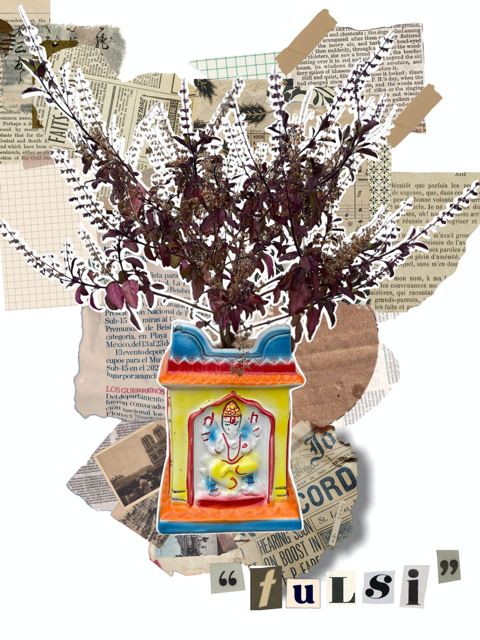
Tulsi. When I say that word to you, you probably have no idea what it means. Maybe you’re thinking that’s a pretty name. And while I would agree with that, I would also add that it’s more than a name, it’s the name of a sacred Indian plant. Tulsi is just one of the 20 plants I grew up surrounded by. My mom is an avid plant lady, though I wouldn’t venture to call her a “gardener” because it’s not like she grows carrots and potatoes although we did have a chili plant on the side of our house at one point. The plants she has are all different essential Indian ones, and the way Indian English operates, she would call them all tulsi.
Ocimum tenuiflorum, commonly known as holy basil or tulsi in Sanskrit, is an aromantic perennial plant in the Lamiac family. It’s widely cultivated throughout the Southeast Asian tropics and native to tropical and subtropical parts of Asia, Australia, and the western Pacific. It’s cultivated for religious and traditional medicine purposes, as well as for its essential oil. It is widely used as an herbal tea and has a place within the Vaishnava tradition of Hinduism, where devotees use it for worship.1
One of her other plants you would know as lemon grass, or lili chai in India,which is a perennial, aromatic tall grass with a light lemon scent used for culinary and medicinal purposes. For centuries, herbalists have used the herb as an effective digestive tonic and nervous system relaxant. The oil of the plant is used to help clear blemishes and maintain a balanced skin tone. Additionally, it’s also used as an insect and mosquito repellent.2
I never really understood the reason why we had the tulsi; it is just became one of those constants in the background of my life that I never really questioned. While it’s used for medicinal purposes, I don’t think my mom ever used it for that. We also have a money plant that I think might be older than I am. It sits in the back corner of our dining room in a green pot elevated on a little black metal table. Although now, it has a cardboard barrier around it to keep our cat away from it. I remember asking my mom about this plant when I was younger and when she told me the name of it, I was fascinated. Wow, a plant that can grow money? That’s amazing! Of course, the expression that “money doesn’t grow on trees” holds true because that plant could not, in fact, grow money. I learned later on that it was called that because it is believed to bring wealth.
The Pachira aquatica goes by many names, including Malabar chestnut, French peanut, Guiana chestnut, Provsion tree, and Saba nut. It is sold commercially under the names Money tree and Money plant. It is a tropical wetland tree in the mallow family Malvaceae that is native to Central and South America where it grows in swamps. It is sometimes sold with a braided trunk and is commonly grown as a houseplant.3
The location of my mom’s herd of plants alternated with the seasons. During the spring and summer, she would put them on the outside steps leading to our front door. It’s kind of ironic now because all the other plant life that used to populate our front lawn slowly diminished over the past few years, to the point that now, it’s a barren grassland. It’s almost like she took all the available plant power and put it in her pots. When the seasons changed and it grew colder towards the middle-end of fall, she would move all her tulsi inside and huddle them all on a table together. This table used to sit right next to the front door, but she has started putting them on our kitchen table, since it was never used anyway, to have them more out of the way.
I was excited when we first got the chili plant, as well as later when we got a cherry tomato one. The idea of growing some of our own vegetables intrigued me, and I loved checking the plants every day to slowly watch the chilis and tomatoes ripen. I’d always wanted my mom to have a full garden in our backyard, but she always told me that she didn’t have the time to care for that many plants on top of the ones she already has. It seems she was right considering that both the chili and tomato plants ended up dying. She did have a mini greenhouse in our backyard that she got off Amazon for around two days, but it got blown over by the wind.
Soon after we got our cat Mochi and my mom noticed him trying to eat her plants, she got some special pet grass for him to eat. It sits on a little side table right next to our microwave, but ironically, it still seems he likes my mom’s plants more than the grass, since he hardly eats the grass and still tries to get to her plants.
Cat grass is typically grown from rye, barely, oat, or wheat seeds. It’s different from grass that naturally grows outside, as that has the potential to contain toxic pesticides. It can be used as a deterrent to lure pets away from dangerous or delicate plants.4
Now when I go home for the holidays, I can still find my mom tending to her tulsi, whispering encouraging words to them and shooing the cat away from their springs.