A Mother’s Love
By Corriehaze Choo






By Salvus Roe
The droning pulled her closer to the gleam. She dimly heard them calling for her, but her curiosity, well, if she had been a cat, she would be dead by now. Plus, someone always seemed to be calling her, telling her, molding her, moving her. The pink granite paving stones lined with perfectly trimmed lilac hedges chided her for being wayward. But, as soon as the stones shifted into hard-packed grey nondescript earth, right after the left she took at the Pan statue, she felt she could breathe again. She slipped off her bejeweled sandals and hid them behind a ratty rosemary bush, the piney-citrusy scent filling the air and covering. . . what was that other scent? She felt safe on the hard-packed dirt and barely acknowledged the imagined whispered condemnation of her fiancé’s maids, who would sigh in mock horror at the dirt and callouses that would surely encase her feet. She wandered toward the glinting silver. She hoped something exotic, something new and wonderful awaited her around the bend. The curve of the hill almost hid what turned out to be cages, and the thought that this might have been done on purpose briefly flashed. She moved closer, breathless from the walk or perhaps from holding her breath.
She ducked behind a large moss-covered rock that had fallen from the hill above so long ago it had forgotten, as young laborers, with gloves to the elbows and masks around their necks decorated with the colors of the House, came around a different bend, laughing and joking. They jostled and ribbed each other about some failed pick-up the night before. She had no reason to hide, she thought, but there she was, her most ancient of nerves warning her out of sight. The group spread out, one per cage. They opened the cage doors, reached in to pull a package closer to the door. The cages, it turns out, were not filled with some animal of vibrant plumage or eccentrically wondrous shape. Instead, each cage contained a bundle. She saw no fighting or even squirming as the harvesters, for that was the only name she could think of for these boy-men, pulled the bundles towards them with a wire hook, faces covered with their masks to keep out the droning flies and hide the smell of feces and urine and something else that sheltered the air. They used delicate, serrated spoons and scraped the small sacs from the front of the bundles, catching the oblong shapes in white sterilized dishes. Her brain, struggling to process, found a memory of a grapefruit spoon used to scrape the last juicy pink membrane from its resting place. With sacs removed, what appeared to be eyes sealed shut could now open, and blue-green orbs looked at her, flashing a moment of recognition. Did she hear a murmur? Did she see movement in the sealed cocoon?
The men worked rapidly through 20 or so cages, each with the same unresisting host for feasting larva pulled close, scraped, and then returned. While deft at their work, the speed with which they worked meant serrated edges caught on the delicate eyelid line, leaving a thin trail of blood. Each set of blood-painted eyes turned to her in one last look before vision was blurred by buzzing. She recognized the other smell; it was unwashed bodies filled with emptiness, edged by sighs and murmurs.
“Take the green ones, you lot! What part of that is hard to understand!” The guttural voice rang out above her. One of the harvesters quickly withdrew his hand from the cage festooned with a yellow streamer and slammed shut the door. Shouts rang down the path as four man-boys dragged a small mewling child around the corner. She thought she recognized him from earlier in the day. A single drop of clear water condensation on the otherwise spotless tablecloth over which she placed her napkin as the quivering servant moved her glass filled her vision for just a moment.
One of the handlers picked up a strip of cloth and began wrapping the child in thick white fabric. It, for she was no longer sure if it was a he, was covered from neck down, wrists tied, and the fabric at the foot end sewn together — a square piece of Mer tail. A slightly less thick swaddling covered hair, ears, mouth, and nose, leaving just the eyes. The papoose was tossed into an empty cage, and a red tag tied to the door. She watched as the gnats descended. Tiny round bodies hurtled themselves at the eyes, alighted, and hurtled themselves away. Tiny scouts waiting to be swatted, having evolved with humans and knowing the back of their hand. The bodies flew into focus, then out, then back in again until finally, recognizing hospitable lands, they alighted, believing themselves safe as their tiny throats gulped down the salt from the now free-flowing tears. Slowly, exposed white globes began to ooze a thick yellow-green membrane. By the time they recognized the need to escape and began frantically flapping and buzzing, it was too late. Each tiny creature lay in its own opaque tomb, the weight lowering the lids until the mucus sealed them shut, with only the rheum flowing, capturing, and sealing. She, shaking, crept from her hide.
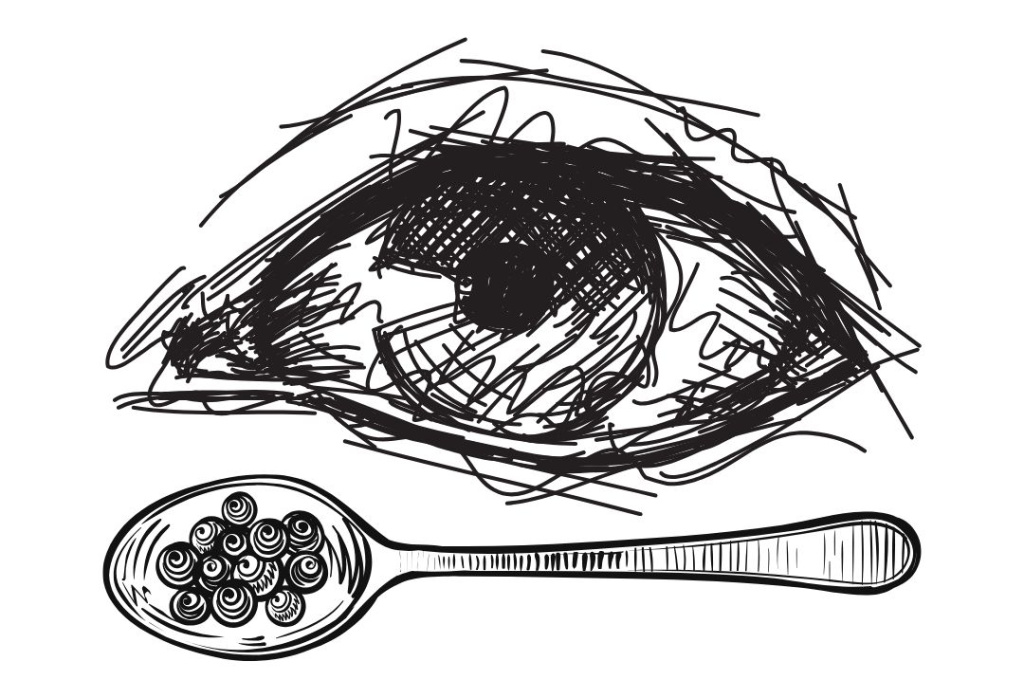
“Darling,” her fiancé said in his affected voice dripping with a paucity of wisdom and wealth of confidence. “Darling, do try this delightful caviar. So far from the sea and yet, so delicious and fresh.”
“Yes,” the mayor agreed. “You must! We harvest it here ourselves. Family tradition from generations back.”
“Such a treat,” murmured one guest dressed all in maroon, spooning the oblong yellow-white morsels into their mouth.
She stared at the arranged public official on her left, willing him to choke on his cravat, but with no other choice, her curiosity fleeting and her primal nerve asking her to once again run, she picked up the mother-of-pearl spoon, crafted so as to ensure no offending or alien taste would interfere with the precious cargo that sat upon it. An outsider might comment on the woman’s delicate demeanor and impeccable manners as she slowly and carefully, elegantly it would seem, reached into the tiny dish at her side and delicately scooped one opaque oblong piece, placing it on her demure tongue. An insider would feel or maybe hear the slight pop of the outer membrane as teeth bit down, and the gentle, sweet-salty ooze that laced the tongue and trickled down the throat.
“See,” her fiancé offered, “so delightful it brings tears to one’s eyes.”
By Kaylee McCracken
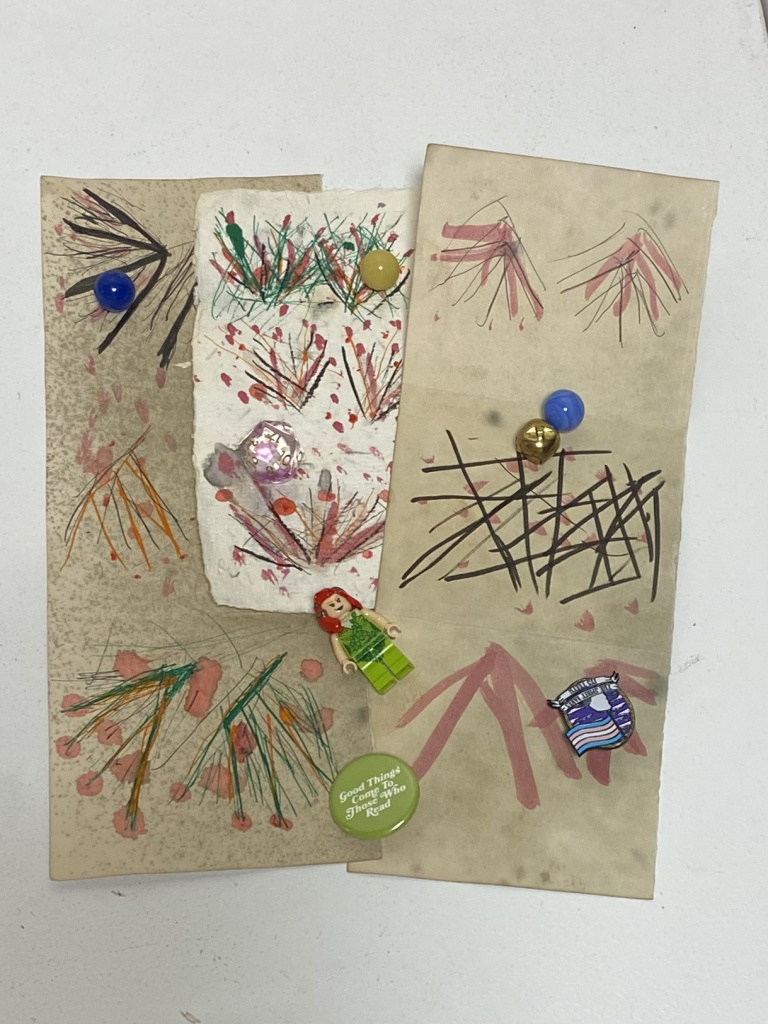
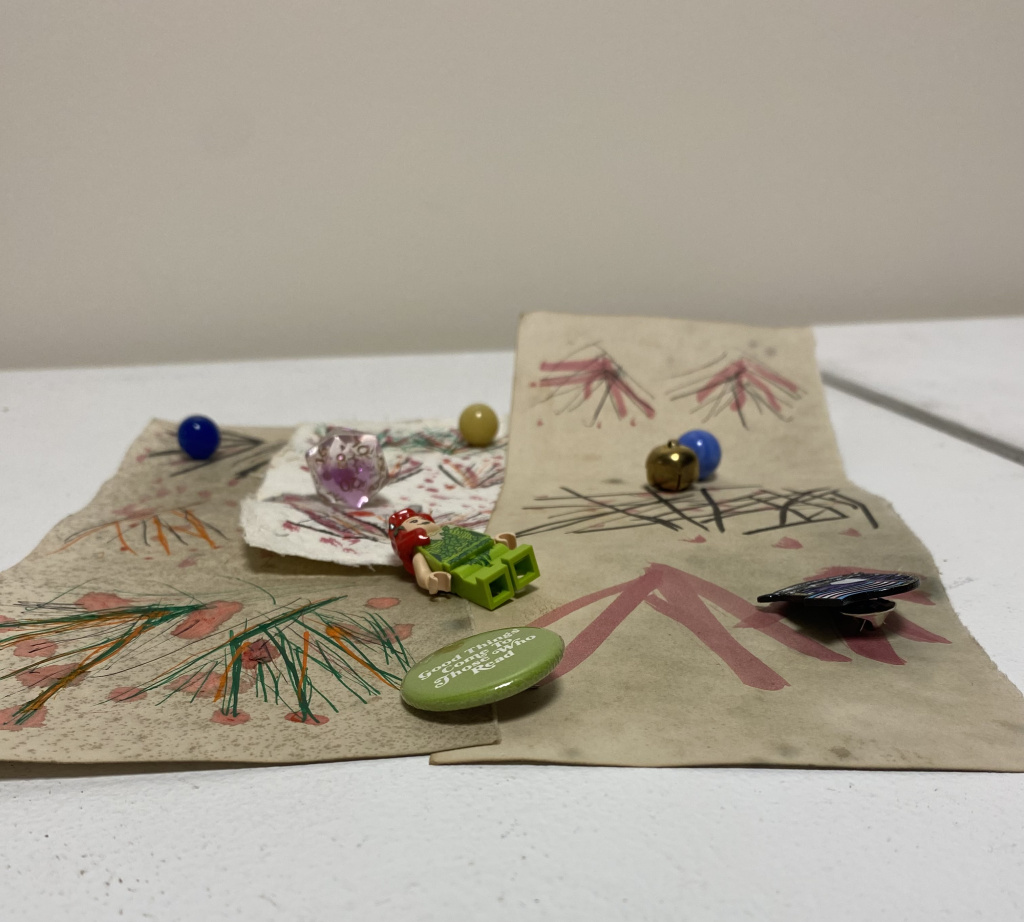
These recordings (see Exhibit 1) mark the end of the Anthropocene for those more concerned with geology rather than whole states. Recorded by [crow] between October 7th, 3039 and October 31st, 3039. Translated by [pigeon] for all known languages and placed in the Worldly Museum of Natural History (previously the American Museum of Natural History) like many other documents not previously recognized by the [bipeds], which (like the rest of our home) has flourished in the new era, rooted in being together, the Simulocene.
Entries translated from [crow]
10/07/3039 [pigeon] concession to the [biped] division of time as an act of goodwill.
The sweet [honeycrisp apple] tastes tart but refreshing; its juice runs down my feathers onto the forest floor. The flesh quells the rumble in my stomach, and the scent transports me to a time when all I knew was autumnal satisfaction – the peace we feel during this change of season. I now know the [tree] that gifted me must be a breathtaking mix of orange, red, and brown, but I can’t see [it]. I can’t see anything anymore even though the colors of the sky used to be the only entertainment I longed for. The smog mixed with the rising heat makes it hard to breathe – let alone admire beauty. It didn’t used to be like this. Not when the [bipeds] sang like the [sparrows] or danced like the [hummingbirds]. When they were friendly. Kind. Kin. When we admired the shimmers and sparkles dancing on the ripples in a river together.
10/13/3039
I was deemed scribe today. My [friend] read my previous entry and brought me to a meeting of the [Murder]; their deliberation was quick and disorganized. It hurt something in me to listen to the conversation. We have had to rapidly adapt our interactions to rely primarily on auditory cues: no more beaks bowed or feathers dramatically displayed to signal seriousness or quiet. Communication efforts are still difficult, so both pauses and miscommunications are frequent. The [Mother] of the [Murder] told me about a final plan to present to the rest of the [avians], and all they needed was someone to keep a careful record of minutes…in case…I’m not really sure. But apparently, they want what I’ve got to offer.
10/15/3039
As of today, there have been a total of 3 meetings – not including the above, with one remaining. First the [avians] had to agree on basic axioms.
The next step was to get the word to the [insecta], who agreed with little qualm. Many were surprised they didn’t beat us to it. Then we met with the [earth walkers], who did not want to see many of the [bipeds] be harmed, let alone ended. While this was a point of contention, upon further stipulations, we reached an agreement that some [bipeds] may be welcomed to stay.
10/16/3039
Many [reptilia] convened near the [oceans] — or what was left of Her. Most of Her has become unlivable, but there are too many scrappy scavengers to kill off yet. Once the [reptilia] returned, the aura of our interactions became angrier. Seeing something firsthand can do that, but we had agreed upon something. We are beginning the healing [death] tomorrow.
10/17/3039
Step one (as described to me) seemed simple: use the basic axioms to determine who may or may not continue. Step one (in actual practice) has been terrifying. Even for me. We should have known that telling all [non-bipeds] that the death of those who have wronged this living [Earth] would be not only encouraged – but a display of celebrated justice – would be mass hysteria and…arguably a war crime. However, it seems to be achieving the goal.
10/31/3039
The bloodbath has continued with little rest. The [bipedal] population has been reduced to 200,000 people. Only those that have been kind and caring enough to impact all the kin in their environment positively have been spared. Today it was established that no more killings will be tolerated (force majeure). Today we – the real we – the new we – the true we – proceed new. This means not the [crows] as new conquerors, but we: all who are left simply as beings being together. We are leaders as we are followers, but none subjected nor othered. We proceed as one body with one goal – to live a life that allows our flourishing. There is no question of when to wake, where to be, how high to jump. There are no possessions and no decisions. There is only the sweet tanginess. The orange and red confetti not yet fallen. The care of and for one and another. The gift of love and life. This is a species of Earth.
By Daisy Cheshire
As I lay here being on by an unseen organism, I look back at how stupid I was. I should have paid attention in my biology class, especially when discussing the kingdom of eukaryotic organisms. In class, Dr. Robert’s voice was just a low hum. My eyes were glued to the window, watching the fleet of polished chrome sedans glide silently between the towering gray buildings. The air was a thick yellow-green haze with the faint scent of ozone and exhaust, a scent I’d become accustomed to that I barely noticed it anymore. All I could think about was getting out of the city, away from the endless concrete. I have always heard stories about an old growth forest located outside of the city walls.
I left the city behind, the smog scent slowly disappearing, giving way to a new clean, alive scent. My electric bike hummed along the dirt road until its battery died, leaving me to walk for hours on foot. Then I saw it. A living monument of a tree, its leaves a shade of green so far different from the green hue in the haze that coats the city most days. My eyes were drawn to a cluster of strange, luminous, fleshy looking things growing from the ground. Their caps a vibrant blue with bright green spots. They looked almost alien, so perfectly out of place. Curiosity, or looking back stupidity, made me kick one. A puff of white spores erupted into the air, surrounding me in a cloud. A few of the specks drifted into my nose and mouth, making me cough and sneeze. Laughing, I inhaled the clean scent deeply. It was so different from what I would have done in the city, completely oblivious to what I had just inhaled.
I spent hours lost in that forest, walking among the silent, ancient structures. The air was so clean that it felt sharp in my lungs. But eventually, the city called me back. It took me almost all night to walk home. When I finally collapsed onto my couch, the smell of stale, poisonous air and processed food felt wrong. I fired up the projector to watch the newest episode of Us vs. It, but the images felt too bright and too loud. A faint, nagging, pain started behind my eyes. I rubbed my temples, trying to ignore it, but it persisted. A constant low, rhythmic, throb. It’s just a headache from all that walking in the sun, I told myself; I was just feeling the impact of another in a long line of bad decisions. As the night continued, the dull ache in my head erupted into a screaming pain. My vision began to blur, filling with black and gray static. I told myself that I just needed to sleep it off, as if I were a machine that could simply power down and restart.
I woke up to the whimsical chime of my alarm. I turned it off and got out of bed. I walked over to turn the lights on and when the bright LED lights turned on, I cried out, hissing in pain. The light felt like daggers stabbing into my eyes. I folded over in pain, grabbing at my head. Then came the voice, a deep agonizing scream that wasn’t my own, echoing inside my skull: “What is that? It burns! It burns!” I fumbled around for my sunglasses, the familiar plastic a quiet comfort against the assault of light. The shouting in my head quieted, but it remained screaming. I tried to follow my morning routine, but I was like a marionette. I kept finding myself doing something opposite to what I had to do. Every time I tried to get work done on my computer, I would find myself walking towards the window. I also couldn’t keep the lights on in my apartment. I stumbled to my bike, letting whatever was growing in my brain take over and lead me back to the woods, back to that ancient tree, taking the same route as the previous day…

I’ve settled my body against the ancient tree. At least my final moments will be the light blue hue of the sky through the interwoven treetops instead of the concrete world I spend most of my days in…
A wet, gurgling cough escapes our throat—
a coarse sponge scraping across the bottom of the sink. We no longer need to scream; the forest’s floor allows us unrestricted comfort—
Another wiry and wet scrape as the oxygen feeds us, the moisture from the air allowing us to expand further into the muscled comfort between our host’s ribs. We place the host’s hand against the ancient tree and curl the host’s spine against the oak’s bark. We’ve come to help. New growth is on its way. We camouflage ourselves in the fallen leaves, the oak lending its resources—understanding the necessity. Here we nestle, ensuring our repopulation effort. Spores float off the host’s flesh, off the host’s tongue, and into the canopy above.
By Mya Rawlings
As he strummed his guitar, the walls breathed. Spores drifted from the rafters like dust, catching the light in slow, deliberate spirals. His tears fell—not onto carpet, but into the moss that had long since replaced it. The strings hummed with something ancient, something buried. I watched from the window of the classroom- or what seemed to be a classroom covered in greenery- my breath fogging the cracked glass, asking myself why. Asking myself how.
Among all the pain and the decay, he played such sweet music. It entranced me. Remarkable, really, that this frail and delicate soul could summon beauty from rot. His strength felt more rooted than mine, like a tree that refuses to die even as the forest around it burns to nothingness. He was using his own grief to survive.
Suddenly, he stopped playing. The silence was thick like a mire. His face fell into his hands, and the vines above him drooped in sympathy. He didn’t know I was watching- didn’t know I could see the grief eating him alive, like mold on fruit. But what made him grieve?
I moved from the window to the cracked door covered in vines, and I peered in. He was standing now, head bowed. His left hand in a fist, his right gripping the guitar like a weapon. His pale skin glowed a disturbing red against the fungal spreading across the walls. The air smelled of mildew and something sweet—like rot pretending to be perfume.
He lifted his head. The tears had slowed, but his eyes burned with something else. Anger. Fiery and spontaneous yet glorious and spectacular. His grip tightened, and I swear I heard the wood groan, like it remembered the forest it came from and the men who had killed it.
Then he moved. Fast. The guitar rose and slammed into the mossy floor. Again. Again. Again. The spores erupted with each blow, filling the room with a choking viridescent haze. My eyes widened and stung. My jaw clenched. The sound echoed like thunder in an empty cave. The guitar splintered; its pieces scattered like bones across the room in every direction imaginable.
When the boy was done, his breathing was ragged. His skin flushed, like a fever. I thought I had seen anger before—but this was different. This was elemental. Gorgeous. Dazzling. Horrific.
My hands trembled with fear from his sudden outburst. I clenched them into fists, trying to stop the shaking. Then—a bang. Loud. Reverberating. The old chair he once sat in was now across the room, overturned and consumed in creeping lichen.
He dropped the last shard of the guitar from his hands and turned. He saw me. Not like I hadn’t wanted him to. But shit, this was something else. I felt true true naked fear.
He moved like a storm toward me. I stumbled back. The door swung open, vines snapping and curling around the door’s hinges like fingers. The wall behind me pulsed, soft and damp. It wanted me. Not to hurt me but simply to keep me.
He backed me against the wall, breath hot, eyes wild. His eyes were not with anger but fear.
“It will consume you.” he said.
But the room echoed it back in hunger. Stomach churning hunger.
He walked off, and I collapsed to the floor. The moss beneath me sighed as if disappointed. And I knew—I wasn’t just a witness. I was becoming part of it now.
I stayed on the floor longer than I should have. The moss beneath me -warm, almost pulsing. My breath came in shallow waves, and the spores in the air settled on my skin like snowflakes. They didn’t sting. They soothed me. The moss became a kindness to the damned.
The boy was gone, but the room wasn’t empty. It was full—of memory, of grief, of something much fearful than either of us. The vines on the walls had begun to move again, slow and deliberate, like they were reaching for something. For me.
I tried to stand, but my legs felt heavy. Not numb but rooted. My fingers brushed the floor and came away damp, flecked with green. I stared at my hands. The skin was pale, but beneath it, something shimmered. Not blood. Not bone. Something else.
I gathered as much strength as I could and crawled toward the shattered guitar. One fragment pulsed faintly, as if it still remembered the music. I touched it, and the room exhaled as if it was a relief.
The vines screamed as they tightened around the windows. The light dimmed. The air grew thick with a scent—earthy, dirty, and slightly sour, like freshly picked overripe fruit. I felt it in my lungs, in my throat, in the space behind my eyes.
The house wanted me. Not violently. Not cruelly. Just…hungrily. Or was it just lonely?
I thought of him, the boy—his rage, his grief, his music. I thought of how the guitar screamed when he broke it. I thought of how the spores danced with every blow. He hadn’t just destroyed something. He’d fed it.
And now, it was my turn.
I stood, legs trembling, and walked to the center of the room. The moss welcomed me. The vines reached down. The spores swirled. I opened my mouth to speak, but no words came. Only breath. Only silence.
The walls pulsed. The floor sighed. But the classroom consumed.
And I let it.